

Pushparaj Vijayakumar 1*, Rajavel Varatharajan 2, Jibi Paul3
Authors:
2Faculty of Pharmacy, AIMST University, Semeling, 08100 Bedong, Kedah Darul Aman, Malaysia
3Professor,Faculty of Physiotherapy, DR.MGR.Educational and Research Institute, Deemed to be University, Velappanchavadi, Chennai, India
Corresponding Author:1*Professor, Rajarajeswari College of Physiotherapy, Kambipura, Mysore Road, Bangalore, Karnataka, India, Mail id: vijayrrc@yahoo.com
ABSTRACT
| Background and objectives: The Cricket is known as “the gentleman’s game” which places physical demand on the players. This demand creates lot of stress on muscles leading to injuries if they lack fitness. Star excursion balance training (SEBT) programme forms a core component of the training among young men cricket players in improving their agility. The less research evidence on 6 weeks of SEBT program has led to design this study to identify whether there is any effect on agility in enhancing the physical performance and prevent the occurrence of injuries among young men cricket players. Method: This was a comparative experimental study conducted on thirty young men cricket players (n=30) of age group ranged between 18 and 22 years. They were randomly selected for two groups as star excursion balance training (SEBT), Group A and conventional exercises training (CET), Group B with fifteen (n=15) subjects in each group. The Group A underwent Star excursion balance training programme and the Group B underwent conventional exercises training programme. The training for both groups was administered for 6 weeks with three sessions per week. Result: The result shows that there is significant improvement with P<0.0001 in agility T test score on performance in Group A and significant improvements in Group B, with P<0.0290. Comparative study between the group shows significant difference between the groups with P<0.0001, with mean difference of 0.060 and -1.453 respectively on Group A and B. So Group A is better than Group B. Conclusion: Six weeks of star excursion balance training programme can be recommended for young men cricket players to improve the agility in enhancing their physical performance and preventing injuries. |
Keywords: Star excursion balance training, Agility T Test, Agility, Young men cricket players.
| Received on 14th August 2020, Revised on 24th August 2020, Accepted on 31st August 2020, DOI:10.36678/IJMAES.2020.V06I03.003 |
INTRODUCTION
Cricket is one of the popular and oldest non-contact bat and ball sport which engages the players in running, throwing and catching during bowling, fielding, wicket keeping and batting. This leads to overuse and impact injuries to the upper limb, lower limb, head and back1. Cricket is one of the sports characterized by many of the basic and variable skills, which is played in several versions, such as long format and short format. The long format is played over for five consecutive days as test matches and the short format includes one day and 20-20 matches.
The demand on the players due to various formats of cricket sport causes physiological overload, which depends heavily on the player’s ability to move quickly and powerfully. This greater stress on the cricketers demands an extreme physical fitness, not only for the performance, but also to prevent injuries. These larger demands are the reflections of frequent touring for the test matches, one day matches and 20-20 matches per season. The sprinting and turning within the wickets , running-up and delivering the ball when fast bowling , causes rapid acceleration and deceleration load on the lower limb musculature2,3. The cause of stress in cricket players is due to sudden starting and stopping nature of sprinting between the wickets, fast bowling and fielding which contributes to onset of fatigue in overtime, resulting with impact of negative performance and increase in the risk of injuries. These intermittent activity in cricketers during bowling, fielding and batting, places them on demand on the physiological and neuromuscular system4,5.
The bat and ball sport led the players to, overuse and impact injuries , at various anatomical sites with the region most vulnerable to injury accounting with 44.9 % in the lower limb, followed by upper limb at 29.4%, the trunk at 20.0% and head and neck at 5.7%. The range of injuries in cricketers varied between 22.8 % to 50.0 % in lower limb among other anatomical sites of injuries6,7.The functional testing of balance and proprioception, strength, range of motion and agility determines whether a patient is able to return to play following an ankle injury8.
Due to the complex skills and rules in cricket, the players require a good physical fitness, skills and efficient strategies for an effective motor task performance in maintaining the body positions during sudden location and directional changes in activities of acceleration and deceleration which demands good balance. This task performance of sudden acceleration and deceleration rapidly with good balance and the ability to change direction or body position rapidly and to proceed with another movement is the ability defined as “Agility”9. The agility is the ability of a player to change position in space or to change direction quickly and effectively. And it is thought to be a reinforcement of programming through neuromuscular conditioning and neural adaptation of muscle spindle, golgi tendon organ and joint Proprioceptors10. The agility is a complex ability depending on coordination, mobility of joint system, dynamic balance, strength and speed. The balance training is effective in improving static postural sway and dynamic balance through neuromuscular control and performance enhancement11. This ability to enhance the maintenance or control of body positions while quickly changing the direction during a series of movements should improve “Agility”12.
The injuries can be an adverse outcome of participation in sports and recreational activities. The impact of injuries during these activities is most associated with cricket players at a value of 242/ 1000 injuries among other sport players. And it is recommended for injury prevention program, aiming at team ball sports (Cricket, soccer and netball) because of their comparatively high rate of both, overall and significant injury13.
Training with rapid stretching of a muscle (eccentric action) immediately followed by a concentric or shortening action of the same muscle produces more force than the force produced by a concentric action alonebecause of the stored elastic energy within the muscle14, 15. The components of stopping, starting and changing direction in the training programs assists in developing agility10,16,17. Training the above components through Star Excursion Balance Training (SEBT) among young men cricket players may be effective in improving the agility by increasing the balance and control of body positions during movements by neuromuscular conditioning and neural adaptation of the Proprioceptors10. But there are less scientific evidences in proving its effect. Therefore the purpose of this study is to determine whether there is any effect of SEBT program for 6 weeks on Agility among young men cricket players.
METHODS
This was an experimental and comparative study. Young men cricket players between the age group of 18 to 22 years, who were undergoing professional cricket training volunteered to participate in this study from the cricket academy at Bangalore. They were screened for selection criteria to include in this study. A total of 30 participants who satisfied the inclusion criteria were incorporated for the study after explaining the procedure and obtaining the signed written consent form. This study was a randomized controlled trial and the selected subjects were randomly allocated into two groups by paper and chit system, Group A (N=15) the training group and Group B (N=15) the control group.
Inclusion criteria: Young men cricket players of age group between 18 – 22 years, participants with agility T score of more than 11.5 seconds, and subjects with stroke balance stand test score of more than 40 seconds.
Exclusion criteria: Subjects withany limb length discrepancy, spinal or lower limb deformities, history of surgery of spine or lower limb or upper limb, history of injury of spine or lower limb or upper limb, history of neurological dysfunction in the lower limb or upper limb, vestibular dysfunction and any visual impairment were excluded from the study.
Materials: Measuring tape, White athletic tape, Four (4) agility cones, Stop watch, Paper and pencil were the materials used to conduct this study.
Measurement tools: Agility T test used to measure the performance of cricket players
Intervention: Star excursion balance training (SEBT) and Conventional exercises training (CET).
Procedures:
This study was designed with a pre and post intervention randomized control trial. Those subjects in training group (Group A) received star excursion balance training (SEBT) programme, while the subject in control group (Group B) received conventional exercises training program. The subject in both the groups were permitted to continue their regular cricket practice, but were not permitted to start any other extremity strengthening and balance training program during this course of study. Rather, they were permitted to perform only the approved training program of this study.
The subjects in both the groups were instructed to come in shorts and barefoot, one week before commencement of the study. They were explained and demonstrated to learn about the variables which have to be executed in the study and were made to practice in a correct manner. The Agility T-test was used as an outcome measure for Agility. On day one of the study, subjects in both the groups underwent a baseline testing as a pretest score and then a posttest score was measured on the last day of 6th week.
Dependent Variable Testing:
The agility T test is a reliable and valid measure for leg speed and secondarily of leg power and agility in lower limb20. The outcome measure was measured using agility T test. Before starting the test, four cones were taken and arranged on the track in the shape of “T”. The four cones A, B, C, & D were arranged perpendicular in the shape of “T”. The cones A and B were arranged perpendicular to Cones C & D. The point between Cone A and B was arranged in 9.14 meters and the point of arrangement between Cone C and D from Cone B was 4.57 meters. After the arrangement of cones the subject was made to stand with both the feet behind the starting point (Cone A) facing towards Cone – B. Then on getting a start signal and by starting the stopwatch, the subject ran from Cone – A towards Cone – B and touched the base of cone – B with the right hand. After touching Cone –B the subject ran towards Cone – C and touched the base of Cone – C with the left hand. Then the subject shuffled towards Cone – D to touch its base with the right hand. After this moment the subject shuffled back towards Cone –B and touched its base with the left hand followed by running towards Cone – A to finish. After crossing Cone – A, immediately the stopwatch was stopped and the total duration of time taken to complete the run between the cones was documented.
Group A: Star Excursion Balance Training (SEBT) group:
Prior to starting of the training program, the preparation for Star Excursion Balance training was performed, initially by selecting a flat and non-slippery surface. Then Four (4) strips of white athletic tapes of 6 feet in length were cut. In order to form the star grid shape on the floor, two strip were pasted in the form of “+” and the other two strips pasted across on the top in the form of “x”. It has to be assured that the stripes pasted are arranged to each other from a center point at angle of 45 degrees with each other. This star shaped grid arrangement involves a series of single-leg squats with the stance limb and a dynamic maximal reach using the non-stance limb to touch a point as far as possible along eight designated lines radiating from a central point at an angle of 45°18,19.
The subjects in the training group were informed to come in shorts and barefoot. To start with each training session the subjects were made to perform 3-minute of warm up followed by Star excursion balance training (SEBT) and conventional exercise training continued with 2-minute of cool down The warm up and cool down included dynamic movements and static stretches.
The subjects from the SEBT group performed the Star Excursion Balance training initially by standing in bilateral stance with barefoot on the middle of the star grid. The weight bearing leg is the stance limb and the unsupported leg is the reaching limb. Then the subjects were instructed to balance their body weight on the stance limb on the middle of the star grid where the strips of tapes are placed at an angle of 45 degrees. By keeping the hands on the pelvis, the subjects were made to reach a distance of 2 feet marked on the tape in all the 8 directional tape positions with the tip of toe of the reaching limb without shifting weight on the reaching limb. The 8 directional tape positions are anterior, anteromedial, medial, posteromedial, posterior, posterolateral, lateral, anterolateral. After each directional reach the subject returns the reaching limb to the start position at the middle of the grid, resuming a stable bilateral stance with 3 seconds of rest between each tape direction. The training with SEBT program was done with 12 rounds in clockwise and 12 rounds in counterclockwise reach. During each session, the subjects were given with a period of 30 seconds rest, to perform the same exercises by changing the stance limb and the reaching limb. The training was administered for 6 weeks with the frequency of three sessions per week.
Group B: Conventional Exercises Training (CET) group:
The subject in the conventional exercise training group performed the following exercises with 2 sets of 10 repetitions per day under the supervision. To start with each training session the subjects were made to perform 3-minute of warm up follow by Conventional Exercises Training (CET) continued with 2-minute of cool down. The warm up and cool down included dynamic movements and static stretches.
Two legs straight knees heel raise – Facing the wall: The subject was made to stand facing the wall with both knees in extended position. Both the feet’s were placed away by shoulder width and in front of a wall away by 6 inches with hands place on the wall at the level of the shoulder. The subject was instructed to raise the heel up on toes as high as possible and hold for a period of 10 seconds and relax for 10 seconds.
Two legs bent knees heel raise – Facing the wall: The subject was made to stand facing the wall with both knees in mild flexed position by placing the patella on the wall. Both the feet’s were placed away by shoulder width and in front of a wall away by 6 inches with hands place on the wall at the level of the shoulder. The subject was instructed to raise the heel up on toes as high as possible and hold for a period of 10 seconds and relax for 10 seconds.
Two legs straight knees heel raise- Facing away the wall: The subject was made to stand facing away from the wall with both knees in extended position. Both the feet’s were placed away by shoulder width and in front of a wall away by 12 inches. The subject was instructed to lean on the wall with the upper back and head supported and to raise the heel up on toes as high as possible while pushing the shoulder back into the wall and hold the heel raise for a period of 10 seconds and relax for 10 seconds.
Two legs bent knees heel raise- Facing away the wall: The subject was made to stand facing away from the wall with both knees in mild flexed position both the feet’s were placed away by shoulder width and in front of a wall away by 12 inches. The subject was instructed to lean on the wall with the upper back and head supported and to raise the heel up on toes as high as possible while pushing the shoulder back into the wall and hold the heel raise for a period of 10 seconds and relax for 10 seconds.
One leg straight knee heel raise – Facing the wall: The subject was made to stand in unilateral stance facing the wall with the stance knee in extended position and foot in front of a wall away by 6 inches. Opposite foot is kept unsupported with hands place on the wall at the level of the shoulder. The subject was instructed to raise the stance heel up on toes as high as possible and hold for a period of 10 seconds and relax for 10 seconds.
One leg bent knees heel raise – Facing the wall: The subject was made to stand in unilateral stance facing the wall with the stance knee in mild flexed position by placing the patella on the wall and foot in front of a wall away by 6 inches. Opposite foot is kept unsupported with hands place on the wall at the level of the shoulder. The subject was instructed to raise the heel up on toes as high as possible and hold for a period of 10 seconds and relax for 10 seconds.
One leg straight knees heel raise- Facing away the wall: The subject was made to stand in unilateral stance facing away from the wall with the stance knee in extended position and feet in front of a wall away by 12 inches. Opposite foot is kept unsupported. The subject was instructed to lean on the wall with the upper back and head supported and to raise the heel up on toes as high as possible while pushing the shoulder back into the wall and hold the heel raise for a period of 10 seconds and relax for 10 seconds.
One leg bent knees heel raise- Facing away the wall: The subject was made to stand in unilateral stance facing away from the wall with the stance knee in mild flexed position and feet in front of a wall away by 12 inches. Opposite foot is kept unsupported. Lean on the wall with the upper back and head supported. The subject was instructed to lean on the wall with the upper back and head supported and to raise the heel up on toes as high as possible while pushing the shoulder back into the wall and hold the heel raise for a period of 10 seconds and relax for 10 seconds.
Forward and Reverse lunge: The subject was made to stand on the ground with your feet hip-width apart from each other. The both hands of the subject were on the side by holding 1kg dumbbells. Then the subject moved the left leg 1 foot forward simultaneously lowering the body until both the front and back legs comes to 90 degrees angle. Here it was instructed that the left leg should not go in front of your toes and at the same time, and also the back leg should not bend down the floor to touch it. Hold this position for 2-3 seconds. Rise above and take your left leg back to complete one rep. Repeat the same with the Right leg. To perform reverse lunges the subject was made to take the foot backward and then bend both legs down to get into a 90 degree angle. Repeat the same with the opposite leg.
RESULTS
The results of this study were analyzed in terms of the total time taken to complete the agility “T” test as an outcome measure indicated by improvement of agility by the enhancement of physical performance and thereby preventing injuries through efficient leg power, balance and speed of activity in the lower limb. The comparison was done between pretest and posttest data.
A total of 30 young male cricket players with age group between 18 to 22 years were included into two groups of SEBT group and CET group with 15 subjects in each. So as to evaluate the effectiveness of agility under this present study, both the intra group and inter group analysis (Group A and Group B) was done among the subjects who underwent star excursion balance training programme (Group A) and conventional exercises programme (Group B).
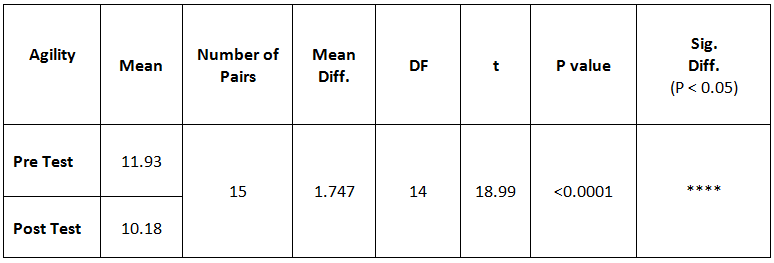
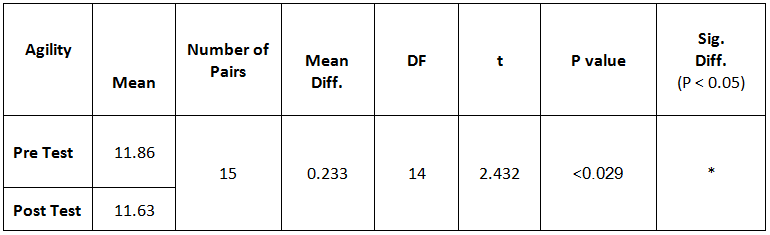
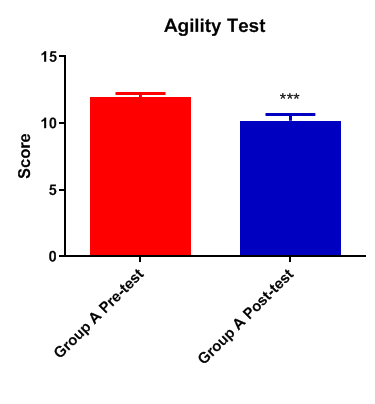
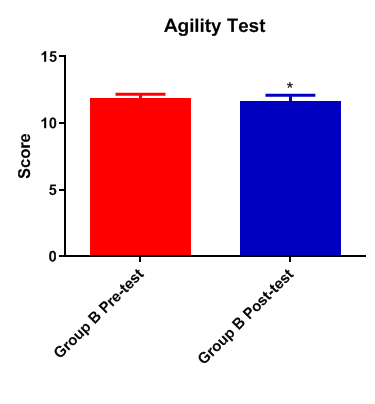
Within group analysis the improvement in agility T test score value for Group A on agility has reduced with mean difference of 1.747, with significant difference of P value > 0.0001, while in Group B agility has reduced with mean difference of 0.233, with significant difference of P value < 0.029.
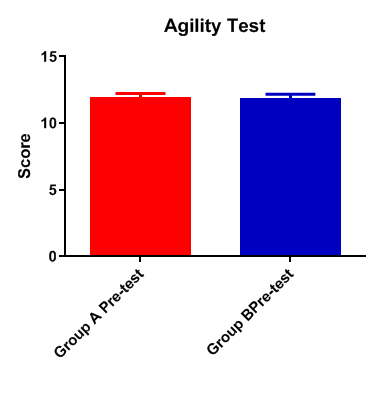
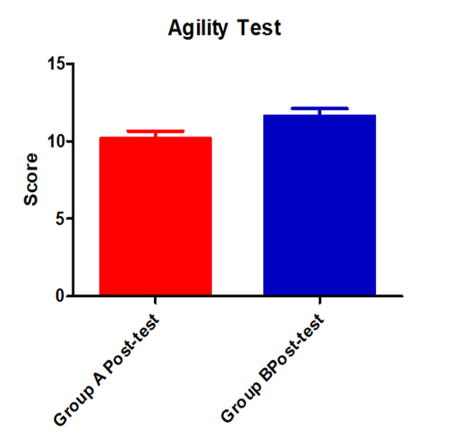
In between group Comparison of Group A and Group B, it has shown no significant difference on the pre- test agility score value with mean difference of 0.06000 and P value of < 0.561. However there was high significant difference in the improvement of post-test agility score value on agility with mean difference of -1.453 and P value of < 0.0001.
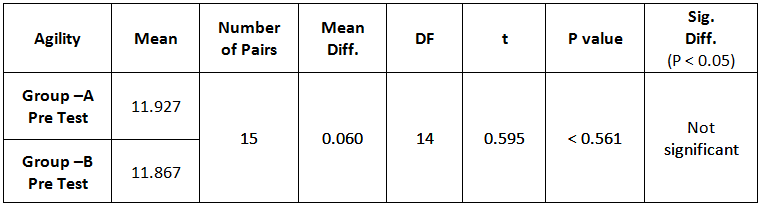
The above table 3 shows no significant difference in the pre-test agility score on agility among subjects between Group A and B with P value < 0.5914.
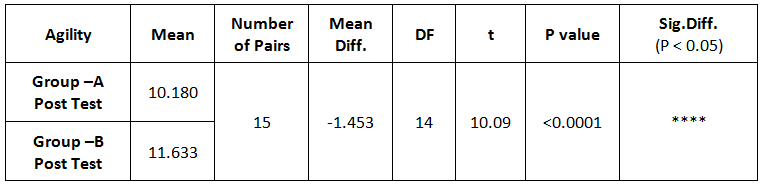
The above table 4 shows statistically significant difference in the post-test agility score in the improvement of agility among subjects between Group A and B with P value < 0.0001.
DISCUSSION
This present study was conducted to compare the effects of star excursion balance training (SEBT) programme versus conventional exercises training programme, in improving agility among young men cricket players. Our current study demonstrated that star excursion balance training (SEBT) administered for 6 weeks with the frequency of three sessions per week has showed statistical significant result in SEBT group and CET group on agility. On comparison between the groups, there was no statistical significant difference between the pre-test score values of agility T test but there was significant difference in effectiveness on agility between the post test score values between the groups. Here it is demonstrated with more effective on the mean difference among the SEBT group when compare with the mean difference on CET group.
This agility T-test is a reliable test for agility which is stated by Pauole et al., (2000)20 that, the agility T-test appears to be a reliable and valid measure of leg speed, leg power and agility which can be benefited as a field test to assess the lower extremity movement in ground based sports and discriminate between low and high levels of sport participation and also supported by Hermassi et al., (2011)21 concluded that total time of agility T-test is significantly associated with explosive muscular power of lower limbs, vertical jump performance and acceleration ability and its result suggest total time of agility T-test has an unique fitness quality to considered as field test that is relevant to be used in training prescription and talent identification.
Our data confirmed that there is improvement on the agility in the subjects of SEBT group through 6 weeks of star excursion balance training programme and less significant improvement on the agility with conventional exercise training programme as measured through Agility T test, which is similar to the previously reported finding by Rogers et al., (2012)22 stating that agility and perturbation are effective than resistance training to reduce and improve function postural control. The Inter group analysis of our study has shown with statistical significance, in improving the agility between the groups with more mean difference in SEBT group. This significant finding suggests that by performing star excursion balance training programme, there is associated contribution of training strength, training ability of balance, training ability of dynamic performance and training compressive loading over the joint in improving the functional performance with good Static and dynamic balance, efficient and quick change in direction of movement, skill to quickly stops and resume the movements which are the core components of agility.
The lesser improvement in agility among the subject in the conventional exercise training programme group may be due to less sensory input programme by dynamic loading on the limb while performing the conventional exercises. We therefore hypothesis that star excursion balance training (SEBT) programme is better than conventional exercises training programme (CET) and may contribute in improving agility among young men cricket players for an efficient performance and prevention of injuries. Studies have adduced evidence by Rogers, Rogers, & Takeshima, 200523 who examined the effect of the ability to balance and stated that this effect of balance is entirely depended on sensory input and muscle strength .The sensory input occurs through visual, vestibular, and somatosensory systems. The visual system contributes to balance, by providing information about the environment, location, and the direction and speed of movement within the environment, whereas the vestibular system, give information about the position and movement of the head. The somatosensory system rules the position of the body and limb through information from receptors and muscle receptors and is similarly supported by Hasegawa et.al (2010)24 stated that the mechanoreceptors respond to any compression or tension during of loading over the limb and the afferent impulse are carried from periphery to central nervous system via spinal level, were it generates motor activity for protective mechanism of the respective joint.
These findings are similar to the findings of Matthews P B (1982)25 that proprioception is used for the regulation of total posture (postural equilibrium) and segmental posture (joint stability), as well as initiating several conscious peripheral sensations (“muscle senses”). This “muscle sense” sensations correspond to the contemporary terms joint position sense (posture of segment), kinesthesia (active and passive), and the sense of resistance or heaviness. Thus, proprioception correctly describes afferent information arising from internal peripheral areas of the body that contribute to postural control, joint stability, and several conscious sensations.
Furthermore, the statistical significance in star excursion balance training (SEBT) group on agility in our study could probably be due to the improvement in the components of postural control strategies. Indeed it has shown significant difference in improvement on agility among SEBT group rather than CET group. Similarly, Chiung-Ling Chen (2014)26 stated that, in the initial phase, rotational perturbation induced earlier ankle movement and in faster and larger vertical center of mass displacement, while translational and forward/toe up perturbations induced larger head and trunk angular change and faster and larger horizontal center of mass displacement. In the reversal phase, balance reaction was attained by multi-joint movements. Translational and forward/toe up perturbations that induced larger upper body instability evoked faster muscle activation as well as faster and larger hip or knee joint movements.
Balance training, the amplitude, velocity and direction of perturbations can be varied to practice in-place or stepping reaction and normal strategy used to respond to an external perturbation can be trained to the patients to offer visions for selecting appropriate support surface perturbations for assessment and for designing methods for training postural control. These findings are similar to findings by Ogaya (2011)27that balance training in elderly people using wobble boards is effective to improve their standing balance by improving their standing time on a wobble board, on a balance mat, and maximum displacement distance of anterior-posterior center of pressure by which they frequently control their center of gravity and maintain a standing posture on unstable surface conditions. And the training on tilt board or uneven surfaces improves the ability to stabilize in an upright stance position. These postural exercises strategy restores body’s center of mass to stabilize through body movement centered primarily on the ankle joints and has significant impact on functional improvements in knee joint.
The result of this study was in compliance with the finding of the study conducted by Sporis et. al.,28 stated that agility training can be used effectively as a training method for improving explosive leg power and dynamic athletic performance. Hence in addition to the well-known method of training such as resistance training and plyometric training, strength and conditioning, athletes may incorporate agility training as well into an overall conditioning programme of athletes striving to achieve a high level of explosive leg power and dynamic performance. This is supported by Miller et al., 200629 that agility is the ability which makes it possible for an athlete to change direction, make quick stops and perform fast, smooth, efficient and repetitive movements and similarly a study conducted by Mayhew, et al. (1989)30 states that agility is highly dependent on coordination and movement control but apart from coordination there is a substantial number of factors that affect the level of agility such as mobility of joints, dynamic balance, power and flexibility, level of energy resources, strength, speed and optimal biomechanical structure of movement.
In an another study conducted by Islam (2004)31, analyzed the effect of an exercise training program challenging the sensory and muscle systems in older adults on Static balance, dynamic balance, maximum excursion, and strength and concluded that there is significant improvement in balance, lower body strength and function. Boeer (2010)32 assessed the changes in balance capacities by recording the total center of pressure excursion with 1-legged stance on the oscillatory Posturomed platform after a 12-week sensory-motor training program for older adults with osteoarthritis and recommended that this training program improves balance abilities and reactions to sudden disturbances and displacements.
Ethical clearance: The ethical approval was granted by the ethical committees of the RRF cricket academy, Bangalore.
Conflict of interest: There was no conflict of interest to conduct this study.
Fund for the study: It was self-financed study.
CONCLUSION
The results of this study indicates that there is improvement on agility among young cricket players with Star excursion balance training (SEBT) program as assessed by the level of dynamic performance and functional tasks in different positions through agility T test. Ultimately, our study stresses the importance of improving the agility through efficient postural swaying strategies, rapid change of direction, explosive leg power, quick stopping and resuming smooth and repetitive movements.
Furthermore, this improvement in agility through SEBT can be a beneficial training programme in demanding the physiological and neuromuscular system among young men cricket players, in improving leg power, balance and speed in lower limb with the ability to sprint suddenly, quickly, powerfully and stop suddenly between the wickets with less impact on the risk of injuries. Therefore, conducting a planned SEBT programme can be recommended for cricket players to improve their agility for an efficient performance and less impact on the risk of injuries.
REFERENCES
- Dinshaw N. Pardiwala, Nandan N. Rao, Ankit V. Varshney. (2017). Injuries in Cricket. Sports Health.10:217-222.
- Noakes, TD. & Durandt, JJ. (2000). Physiological requirements of cricket. Journal of Sports Sciences, 18:919-929.
- Christie, CJ, Barford, G., Sheppard, B. (2011). Concentric and eccentric strength changes in the lower limb musculature following repeated sprints between the wickets. Proceedings of the 4th World Congress on Science and Medicine in Cricket. 31 March–01 April, 2011: 82.
- Davis .R, Du-Randt.R, Venter D, Stretch R.Cricket. (2008). Nature and incidence of fast bowling injuries at an elite junior level and associated risk factors. South African journal of sports medicine. 20(4): 115-119.
- Bartlett RM. (2003). The science and medicine of cricket: An overview and update. Journal of Sports Science. 21: 733-752.
- Stretch RA. (1993). The incidence and nature of injuries in first league and provincial cricketers. South African medical journal. 3: 339-342.
- Stretch R.A. (2003). Cricket injuries: A longitudinal study of the native of injuries in south Africa cricketers. British journal of sports medicine. 37: 250-253.
- Clanton, T. O., Matheny, L. M., Jarvis, H. C., & Jeronimus, A. B. (2012). Return to play in athletes following ankle injuries. Sports Health, 4(6), 471-474.
- Gabbard, Carl, Leblance, Elizabeth and Susan, (1987). Physical education for children. New Jersey: Prentice Hall, Inc. p. 120-124.
- Chaig.BW. (2004). What is the scientific basis of speed and agility? Strength and conditioning journal. 26 (3): 13-14.
- Zech, A., Hübscher, M., Vogt, L., Banzer, W., Hänsel, F., & Pfeifer, K. (2010). Balance training for neuromuscular control and performance enhancement: a systematic review. Journal of athletic training, 45(4), 392-403.
- Twist P.W., Benicky D. (1996).Conditioning lateral movements for multi-sport athletes: Practical strength and quickness drills. Strength and Conditioning 18(5):10-19
- Finch, C., & Cassell, E. (2006). The public health impact of injury during sport and active recreation. Journal of Science and Medicine in Sport, 9(6), 490-497.
- Baechle T.R., Earle R.W. (2000) Essentials of strength training and conditioning. 2nd edition Champaign, IL: National Strength and Conditioning Association.
- Miller M.G., Berry D.C., Bullard S., Gilders R. (2002). Comparisons of land-based and aquatic-based plyometric programs during an 8-week training period. Journal of Sports Rehabilitation 11, 269-283.
- Miller, J.M., Hilbert, S.C. and Brown, L.E. (2001). Speed, quickness, and agility training for senior tennis players. Strength and Conditioning 23(5): 62-66.
- Young W.B., McDowell M.H., Scarlett B.J. (2001). Specificity of spring and agility training methods. Journal of Strength and Conditioning Research 15: 315-319.
- Gray, G. W. (1995). Lower extremity functional profile. Wynn Marketing, Incorporated.
- Gribble PA. (2003). The Star Excursion Balance Test as a measurement tool. Athl Ther Today. 8(2):46–47.
- Pauole K, Madole K, Garhammer J, Lacourse M, and Rozenek R. (2000). Reliability and validity of the T-test as a measure of agility, leg power, and leg speed in college-aged men and women. J Strength Cond Res 14: 443–450,
- Hermassi, S., Fadhloun, M., Chelly, M. S., & Bensbaa, A. (2011). Relationship between agility T-test and physical fitness measures as indicators of performance in elite adolescent handball players. Pedagogics, Psychology, Medical-Biological Problems of Physical Training and Sports. 1 (5)125-130.
- Rogers, M. W., Tamulevicius, N., Semple, S. J., & Krkeljas, Z. (2012). Efficacy of home-based kinesthesia, balance & agility exercise training among persons with symptomatic knee osteoarthritis. Journal of sports science & medicine, 11(4), 751.
- Rogers, M.E., Rogers, N.L., & Takeshima, N. (2005). Balance training in older adults. Journal of Aging and Health. 1: 475–486.
- Hasegawa, R., Islam, M. M., Nasu, E., Tomiyama, N., Lee, S. C., Koizumi, D., & Takeshima, N. (2010). Effects of combined balance and resistance exercise on reducing knee pain in community-dwelling older adults. Physical & Occupational Therapy in Geriatrics, 28(1), 44-56.
- Matthews P B. (1982) .Where does Sherrington’s “muscular sense” originate? Muscles, joints, corollary discharges? Annual Review of Neurosciences. 5:189–218.
- Chiung-Ling Chen, Shu-Zon Lou, Hong-Wen Wu, Shyi-Kuen Wu, Kwok-Tak Yeung & Fong-Chin Su. (2014). Effects of the type and direction of support surface perturbation on postural responses.50,2-12.
- Ogaya, S., Ikezoe, T., Soda, N., & Ichihashi, N. (2011). Effects of balance training using wobble boards in the elderly. The Journal of Strength & Conditioning Research, 25(9), 2616-2622.
- Sporiš, G., Milanović, L., Jukić, I., Omrčen, D., & Sampedro Molinuevo, J. (2010). The effect of agility training on athletic power performance. Kinesiology: international journal of fundamental and applied kinesiology, 42(1), 65-72.
- Miller, M.G., Herniman, J.J., Ricard, M.D., Cheatham, C.C., & Michael, T.J. (2006). The effects of a 6-week training program on agility. Journal of Sports Science and Medicine. 5: 459-465.
- Mayhew, J.L., Piper, F.C., Schwegler, T.M., & Ball, T.E. (1989). Contributions of speed, agility and body compositionto anaerobic power measurements in college football players. Journal of Applied Sports Science Research. 3(4): 101-106.
- Islam, M. M., Nasu, E., Rogers, M. E., Koizumi, D., Rogers, N. L., & Takeshima, N. (2004). Effects of combined sensory and muscular training on balance in Japanese older adults. Preventive medicine, 39(6), 1148-1155.
- Boeer, J., Mueller, O., Krauss, I., Haupt, G., Axmann, D., & Horstmann, T. (2010). Effects of a sensory-motor exercise program for older adults with osteoarthritis or prosthesis of the hip using measurements made by the Posturomed oscillatory platform. Journal of geriatric physical therapy, 33(1), 10-15.
| Citation: Pushparaj Vijayakumar, Rajavel Varatharajan, Jibi Paul (2020). Effect of star excursion balance training program on agility among young men cricket players , ijmaes; 6 (3); 784-798. |
Leave a Reply